
TLDR: The Asus AC3100 is the Best VPN Router in 2022
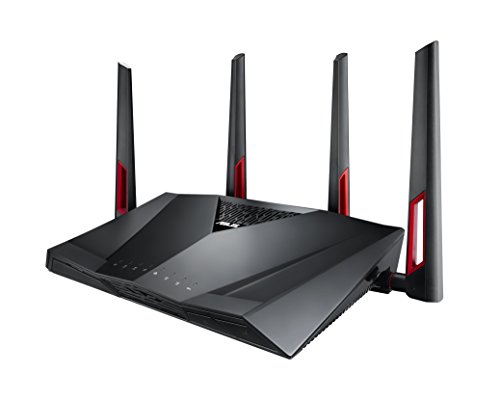
- 1024 Qam technology 80 percent faster 5 GigaHertz at up to 2100 Mbps, 66 percent faster 2. 4 GigaHertz at up to 1000 Mbps; utilities: firmware restoration
- 33 percent greater 2. 4 GigaHertz coverage with a 4 transmit, 4 receive (4T4R) antenna design, able to reach our widest ever coverage up to 5000 square feet
- Expansive connectivity options: with exclusively has 8 x Gigabit LAN ports for up to eight Ethernet compatible devices to connect simultaneously
🥇NordVPN is the Best VPN in 2022🥇
🔥Click The Button below and sign up for NordVPN for FREE With A 30-day Money Back Guarantee!🔥
Click Here To Get 70% OFF NordVPN

Time and again, we have talked about how in this modern age you must use a VPN. It only protects your identity online but has many other advantages as well. But how will you protect the devices that don’t support a VPN or have no user interface at all? Well this is where we can set up a VPN on your router. This will ensure that every device that is connected to the router will be sending its traffic through the safe tunnel of a VPN. Today we will be looking at how we can set up a VPN on a router. We will also see some of the best VPN routers available currently as well as the best VPNs that we should use along with the routers.
Table of Contents
How does a VPN Router work
A VPN which stands for Virtual Private Network creates a secure connection between the user and the internet. It works by routing the users’ internet through VPN’s private server instead of the users’ internet service provider (ISP). So all of the users’ traffic requests through an encrypted tunnel to its servers. This way no one can access the users’ data. On normal devices, you just install the VPN client app and connect to the VPN through the user interface. Once connected, all the users’ requests will go through the VPN tunnel. Hence, your connection will be private and secure.
But how do you connect a device with no Interface to a VPN? Well this is where a Router will come into play. For that you just set up a VPN on a router. Once that is done, every device that is connected to the router will be sending its traffic through the safe tunnel of the VPN. This includes all kinds of devices, even your smart home devices.
How To Set up a VPN on a router
Setting up a VPN on a router is easier than it seems. But before you set a VPN up, you should have a router that supports VPN functionality. You can check on the Router’s website to check if that particular model has VPN functionality. You could also check on the VPN provider’s website to see if you can run it on that particular model. If your router doesn’t support these, we will be mentioning a few supported routers, later in the article. So, there are three main steps to set up a VPN on a router. They are as follows:
- Logging in: To begin with you need to log in to your router to be able to change any of the settings. To log in to your router you will need to know its IP address. Once you know that, you enter the IP address in a browser. This will redirect you to the routers setting page and will prompt you to enter the username password. After you log in successfully, you can change any of the router’s settings. This is the second step of the process of setting up a VPN on your Router.
- Configuration: Once you have logged in, you need to configure some settings to properly set up the VPN. These steps differ depending on your router brand and its firmware. If you are lucky, your router may have integrated VPN functionality by default. If it doesn’t, then don’t worry. It’s very simple. You just need to configure the router’s settings and reconfigure it to redirect all the traffic to a VPN server. To get more detailed instruction that is more specific towards your router, you can check out the manufacturer’s website or the manual that comes with the router.
- Testing: This step is more of a confirmation that your VPN is all set up and is working properly. So once you’ve configured the router’s settings and reconfigure it to redirect all the traffic to a VPN server you need to test it to see if it is working. So unless you have messed something up, which is very unlikely, your VPN should be all set up. Now every device that is connected to the router will have its traffic redirected through a VPN server.
Everything has its advantages and disadvantages. So let’s see the pros and cons of setting up a VPN on a router.
Reasons to use a VPN with your Wifi Router
- 24X7 security: When you have a router VPN, you don’t have to worry about remaining connected to the VPN. Because since the router has been set up, you’ll always be connected to the VPN server. So unless your router stops working, all your connections will remain safe and secure.
- No additional Setup: Now because the router has been set up every device that is connected to the router will have its traffic redirected through a VPN server. These include all your home devices. It will also work on all new devices without having to do any additional setup. This applies to every device connected to your router.
- VPN on unsupported devices: Setting up a VPN on your router will also let you use a VPN on unsupported devices. This includes home security systems, media systems, and all your IoT devices. So now, all these devices will also have the security of a VPN.
- Connect Multiple devices: Most VPN providers have a limited number of devices that you can connect to simultaneously at a particular time. But because all the devices connected to the router will use a single VPN configuration, it will be considered as a single device only. So now you can connect as many devices as you want. However, this isn’t recommended because having a large number of devices connected may make the network unstable.
Downsides to using a VPN with Wifi Router
- Inconvenient Management: Normally you could change the VPN settings on a device using its client app. But because there is a very minimal user interface on the router, this becomes a little harder. You can still change the setting on a router but using the client app would be more convenient. Changing the settings and the country is much easier on a VPN client app. You can still change the setting on a router, but it is slightly inconvenient.
- The router acts as Bottleneck: Many routers don’t support any of the advanced configurations and features of the VPN. They mostly support basic encryption or tunneling protocols. So the router acts as a bottleneck if you want to access any of the other advanced features.
- Incoming Blocks: There may be times where the router blocks unwanted connection because it is designed to block incoming unauthorized connections. This will occur more in the case of devices without any user interface. So they might be rendered inaccessible from outside as they won’t be able to initiate any connections.
Advantages of a VPN?
Now you might be wondering what are the advantages of having a VPN. You would want to know what is the need for it and what are some of its use cases. You would also want to know whether VPN is a must and you won’t be able to access the internet without it. The answer is that it isn’t required to be connected to a VPN while accessing the internet. It’s just that using a VPN makes your connection secure and anonymous. Let us now see some common uses of a VPN.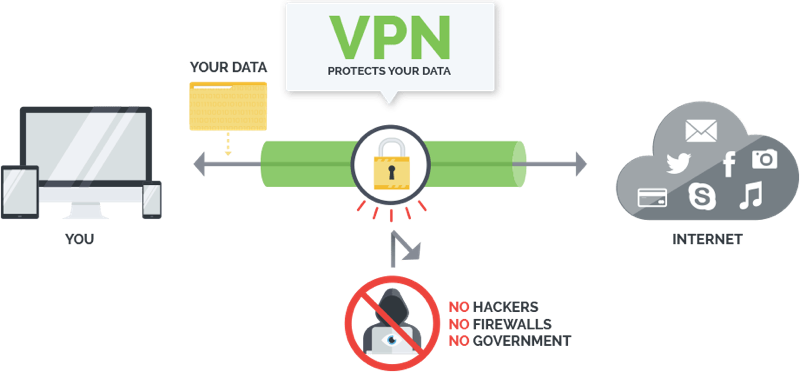
- Hide Your Browsing Activity: Whenever you browse the internet, your Internet Service Provider can see what websites you are visiting and what files you are downloading. Not only this, but even other prying eyes will also be able to track your activity. This data can be sold to third parties who might use it for malicious activities. So if you want to hide your browsing activity from your ISPs and other third parties then you can connect to a VPN. Using a VPN your connection becomes secure and anonymous. On the local network only a single connection will be visible. All the other traffic that needs to be transferred will pass through the VPN connection. This way your Internet Service Provider (ISP) or Governmental agency won’t be able to track you. They will not be able to link your session with your IP address. However one thing you should keep in mind is that VPN providers may still track and log your activity.
- Bypass ISP throttling: Most Internet Service Providers (ISP) intentionally slow down the speed of a user’s broadband internet connection. This is usually done by the ISPs to regulate a network’s traffic and to alleviate network congestion. While this is a common practice the result of this throttling is that users get a lower speed than they were supposed to. This throttling can be bypassed by using a VPN. A VPN routes your connection through their secure tunnel, preventing your ISP from throttling your connection.
- Unblock Geo-Restricted Content: Imagine these scenarios. You are someone who is traveling to a different country and want to access your native Netflix or Prime Video library. Or you are someone who wants to access the catalog of a different country because a particular title isn’t available in your region. Normally you would be out of luck in both these scenarios but using a VPN can easily solve these problems for you. A VPN will mask your location based on the server you are connected to. This enables you to access these region-restricted services from anywhere in the world.
- Bypass Internet Censorship: Many countries are known for notoriously censoring a majority of the online content as well as restricting access to many websites. China is one such country that comes to mind. In such cases you can use a VPN to gain access to these restricted contents. However one thing to note is that most VPNs aren’t capable of bypassing this.
- Downloading Torrents: Downloading torrents might land you in trouble in multiple countries. Even if it isn’t illegal, downloading a torrent can be painstaking because most ISPs throttle the speed. Some ISPs might even serve you notices for downloading torrents. Universities and other Institutes also block torrents. Using a VPN you can bypass these restrictions and also ensure that you don’t land in trouble.
Best VPN WiFi Routers in 2022
These are our top 5 picks for the best VPN routers in 2022 in no particular order.
1. Asus RT-AC88U AC3100
The Asus RT-AC88U is a dual-band 802.11ac Router. It uses Multi-User Multiple Input, Multiple Output (MU-MIMO) technology. This means that it can serve multiple clients at a time without having any effect on the bandwidth. Its1024-QAM technology makes it 80 percent faster. So you get 5GHz at up to 2100mbps, and a 66 percent faster 2.4GHz at up to 1000mbps. The coverage is a wide area of up to 5000 square feet thanks to its 4 transmits, 4 receives (4T4R) antenna design, and a 33 percent greater 2.4GHz coverage. Connectivity-wise you get 8 x Gigabit LAN ports for up to eight Ethernet-compatible devices that you can connect simultaneously.
The router can reach download/upload speed of up to 1.8gbps thanks to its all-powerful 1.4 GHz dual-core processor. With Smart Connect it can automatically choose the best band available. It comes with the ASUS AiProtection which is powered by Trend Micro. It is a combo of automatic vulnerability detection, malicious site blocking, and parental controls which keeps you safe and secure when you are online. You can also connect to other compatible ASUS routers and create a powerful and flexible whole-home Wi-Fi network. This is possible because of the AiMesh support that it comes with.
- Multi-User Multiple Input, Multiple Output (MU-MIMO) enabled.
- Speedy throughput performance in testing
- Eight Gigabit LAN ports
- AiMesh compatible
- Dual-WAN
- Lots of features
- Expensive.
- Mediocre NAS performance
- Inconvenient USB 3.0 port placement
2. D-Link Ultra AC5300 Tri-Band Wi-Fi Router

The D-Link AC5300 Ultra Wi-Fi Router (DIR-895L/R) is a fully loaded tri-band router. It comes with Tri-Band speed (1 x 1000 Mbps in 2.4GHz + 2 x 2167 Mbps in 5GHz) and can support more than 15 Wi-Fi devices at a time which gives you the ultimate Wi-Fi performance. The 4 x 4 data streams and 1024-NitroQAM technology lets you play online games and also stream 4K/HD video at the same time without any lags. It has a powerful 1.4GHz Dual-Core processor and 8 High Power Antennas. So you get very fast wired and wireless speeds and better Wi-Fi coverage throughout your home. It is Multi-User Multiple Input, Multiple Output (MU-MIMO) enabled which gives impressive Wi-Fi signals to multiple devices simultaneously. The advanced SmartConnect automatically allocates the best available band and the AC SmartBeam tracks all the connected devices. This gives you optimal Wi-Fi performance, enhanced Wi-Fi speed, and a greater range. Users get a seamless delivery thanks to the Intelligent QoS traffic optimization.
- Antennas are Upgradeable
- 5GHz throughput speeds
- Multi-User Multiple Input, Multiple Output (MU-MIMO) enabled
- Impressive file-transfer speeds
- Highly configurable
- Unsupported Wireless bridging
- Expensive
3. Linksys WRT 3200 ACM router
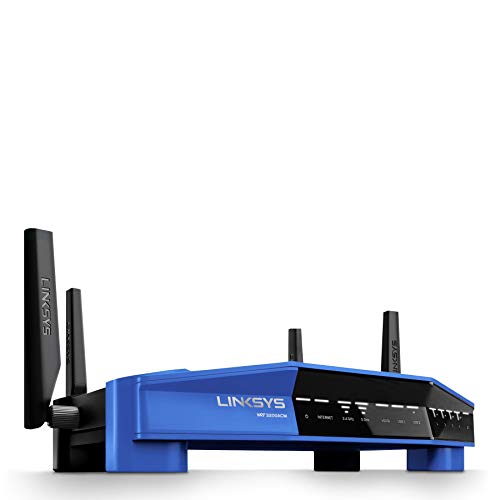
The Linksys WRT 3200 ACM router comes with Tri-Stream 160 technology, which doubles the bandwidth from 80MHz to 160MHz so even if the Wi-Fi network is extremely busy, the Linksys WRT 3200 ACM will still be able to provide superfast Wi-Fi speeds. It has MU MIMO (Multi-User Multiple Input Multiple Output) enabled so you can connect multiple devices at a time to the router without losing any bandwidth. It also comes with a 1.8GHz dual-core processor. It has 512MB RAM and 256MB flash memory. You get four Gigabit LAN ports for four Ethernet-compatible devices that you can connect simultaneously. There’s also a fifth port that you can use to connect to your modem. Its dual-band WiFi speeds can reach up to 2.6 Gbps (2.4 GHz / 600 Mbps) + (5 GHz / 2600 Mbps). It has an open-source firmware and allows you to do some advanced customization. There’s also a USB 3.0 port so that you can transfer files.
- Open source firmware
- MU-MIMO capable
- Tri-Stream 160MHz
- 5GHz throughput speeds
- LEDs might become pale
- Very few 160MHz clients
4. ASUS AC2900 WiFi Router
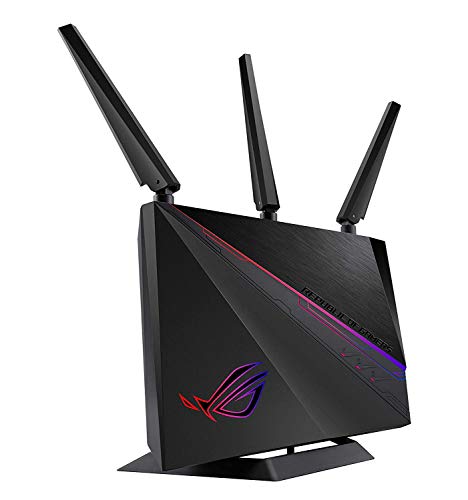
The ASUS AC2900 is a dual-band gigabit wireless router. It comes with the latest 802. 11AC MU-MIMO ( Multi-User Multiple Input Multiple Output) technologies. Combined with MU-MIMO and Dual-bands (2. 4 + 5 GHz) AC2900 it can reach data transfer speeds up to 2900 Mbps. It has a powerful 1. 8GHz 32bit dual-core processor. There are 4x Gigabit LAN ports for up to four Ethernet-compatible devices that you can connect simultaneously. This optimizes the network traffic and enables you to get higher speeds. It comes with WTFast game Accelerator and Adaptive QoS that give you lag-free online gaming experience. You can also stream up to 4K UHD without any hassles. It also has the Trend Micro powered protection which gives you a 24/7 protection online. It neutralizes external attacks and threats even before it reaches your network or any connected devices. There’s an included USB 3. 1 Gen1 port that you can use to transfer files at high speed. The ASUS router app lets you manage your network. You can set up your network, manage usage and parental controls, and even get instant notifications about important network-based events.
- Extensive firmware
- Impressive speed
- MU-MIMO capable
- Customizable
- Long-distance Coverage
- Optimized for Gaming and Streaming
- Built-in stand
- Firmware is a bit intricate
- Average throughput
- Slightly expensive
5. NETGEAR Nighthawk X4S Smart WiFi Router
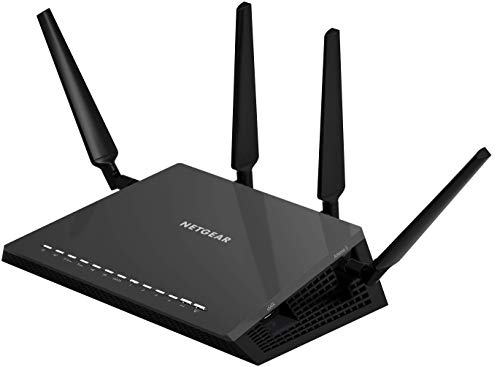
The NETGEAR Nighthawk X4S Smart WiFi Router is a dual-band router that can go up to 800 + 1733 Mbps. It is an 802.11ac model and also supports MU-MIMO (Multi-User Multiple Input Multiple Output) data streaming. It has a 1.7GHz dual-core processor. It comes with 4 x 1 Gigabit Ethernet ports which let you maximize the throughput speeds by delivering four data streams to each band. It has got 2500 square feet of wireless coverage. There’s also a Wi-Fi Protected Setup (WPS) button for additional security. You will also find a button that can disable one or both radio bands.
Its wired ethernet ports let you plugin computers, game consoles, streaming players, and other nearby wired devices. It is very secure and supports WPA2 wireless security protocols. You also get Guest WiFi access, DoS, Firewall, VPN, and much more with the Nighthawk X4S. There are 2 x 3.0 USB and 1 x eSATA ports so that you can share a storage drive with any connected device. So you can create personal cloud storage that you can access from anywhere. You also get Smart parental controls with the Nighthawk app that lets you manage device internet access and can also filter websites with it.
- 2.53Gbps of wireless bandwidth
- High-speed 5GHz rates
- MU-MIMO enabled
- 2 USB 3.0 ports an 1 eSATA port
- Expensive
- Mediocre user interface
- Poor network storage performance
- 2.4GHz is unreliable
Best VPN for Your WiFi Router
While there are tons of VPNs available, our top two picks for your routers are NordVPN and ExpressVPN.
1. NordVPN
When it comes to VPN, NordVPN is one of the leading providers out there. They pretty much excel in almost every aspect. Let us see how they fare against our criteria.
Get 70%+ Discount With NordVPN
Privacy
NordVPN is based in Panama, which doesn’t have any data retention laws. So that means your data won’t reach any authorities or government agencies. So that’s a plus. Moreover, NordVPN has multiple protocols that will secure your connection. It supports the following protocols:
- OpenVPN
- IKEv2/IPsec
- L2TP/IPsec
- PPTP
- SSTP.
NordVPN also has many other features that ensure you are always protected.
Kill Switch: If your VPN connection is ever interrupted or if the connection fails, NordVPN will make sure to immediately stop any kind of traffic from either entering or leaving your device. So your personal information including your IP address will not be exposed to your ISP or any other prying eyes.
Private DNS: NordVPN uses its own private Domain Names System(DNS). This means all the DNS queries of the users will go through an encrypted tunnel. These queries are then resolved on the same VPN server the user is connected to. So there will be no activity logs, no connection logs, no DNS blocking, and no third parties.
Advanced Encryption Standard (AES): NordVPN uses AES encryption in all their connections. They use 256-bit key encryption along with AES. They also use a 4096-bit RSA key to privately communicate with all your devices.
Double VPN: NordVPN will pass your data through multiple servers. It will encrypt your data at every server. So all your data is protected with an extra layer of encryption which makes it even harder to decrypt.
Strict No log Policy: NordVPN claims that they don’t log any of your online activity. They do not store connection timestamps, session information, used bandwidth, traffic data, IP addresses, or other data.
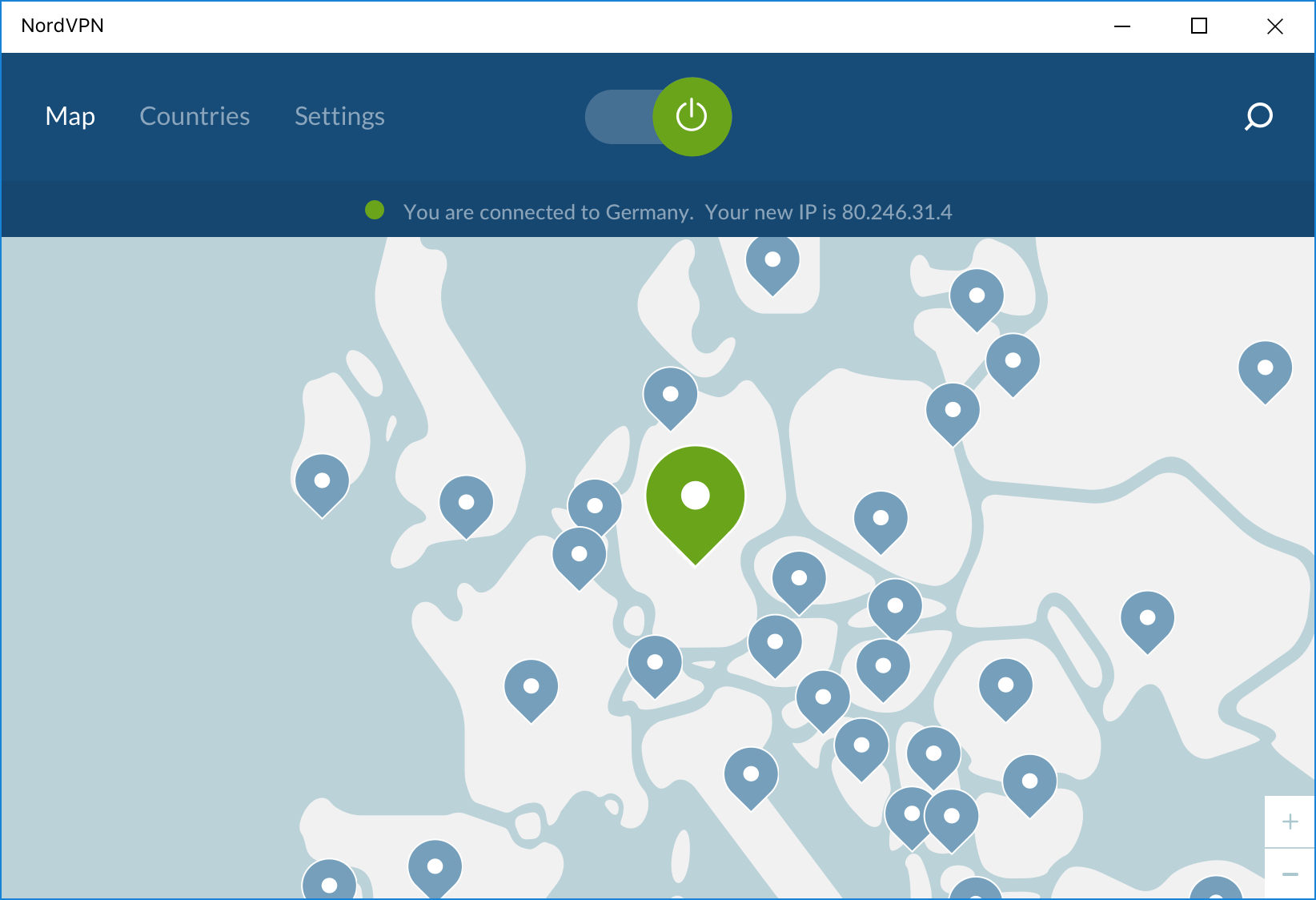
Servers: NordVPN currently has a total of 5679 servers spread across 59 countries. Each of these servers has a dedicated IP address. They also have, what they call, Obfuscated servers. So if you’re located in a country that has a strict restriction on Internet access, you can use these servers. All of these servers have a high-speed bandwidth.
Pricing
NordVPN has a few quite affordable plans. They have 4 different plans:
- Monthly: This is the shortest and the most expensive of all its plans. It costs $ 11.95 for a single charge. For a one year period it will cost $ 143.40. This plan is billed once every month.
- 1 Year plan: The subscription for this plan is priced at $ 83.88. This comes with a 41 % discount which saves a total of $ 59.52. The per month cost for this plan is $ 6.99 which is almost half in price compared to the monthly plan. This plan is billed once every year.
- 2 Year Plan: This is an even longer plan with an even better saving. The subscription for this plan is priced at $ 119.76. This comes with a 58 % discount which takes the savings to a total of $ 167.04. The per month cost for this plan is $ 4.99 which is less than half the price of their monthly plan. This plan is billed once every 2 years.
- 3 Year Plan: This is the best plan that NordVPN has to offer. The subscription for this plan is priced at $ 125.64. For an additional $ 5.88 you get an extra year of subscription. This plan comes with a 70 % discount which takes the savings to a total of $ 304.56. The per month cost for this plan is $ 3.49. This plan is billed once every 3 years.
Get 70%+ Discount With NordVPN
2. ExpressVPN
Click The Button below and sign up for ExpressVPN for FREE With A 30-day Money Back Guarantee!
Get 30 days Free Trial of ExpressVPN
ExpressVPN is the other big name when it comes to VPN. Like NordVPN they also have been leading the market for some time now. Let us see what ExpressVPN has to offer.
Privacy:
ExpressVPN is based in the British Virgin Islands which has no data retention laws. ExpressVPN supports the following protocols:
- OpenVPN with UDP
- OpenVPN with TCP
- L2TP/IPsec
- PPTP
A few more features of ExpressVPN are:
IP address masking: ExpressVPN uses an encrypted tunnel to connect your device and the internet. During this it masks your IP address with its IP address. This makes it impossible to trace your internet activity back to you.
Network Lock: Network Lock is to ExpressVPN what Kill Switch is to NordVPN. So whenever your VPN connection is disturbed, Network Lock comes into play. It blocks all internet traffic. This prevents your IP from being exposed.
Zero-knowledge DNS: ExpressVPN has its DNS that it runs on each of its servers. That means that your activities are private. This is because your personally identifiable data is never stored on any server. So there will be no activity logs, no connection logs, no DNS blocking, and no third parties.
VPN split tunneling: This is a feature using which ExpressVPN excludes certain traffic from the protection of its VPN encryption. According to their official website, with a split-tunneling VPN, you can:
- Stream foreign movies while using web services from local IP addresses
- Download safely without slowing down your other web activity
- Access your network printer while surfing the internet securely
So using Split Tunneling you protect only that traffic that you need to protect.
Best-in-class Protection: ExpressVPN uses AES (Advanced Encryption Standard) with 256-bit keys to encrypt your information. Also known as AES-256, it is used by security experts worldwide to protect classified information. This means that your data is safe with ExpressVPN
Bypass ISP throttling: ExpressVPN also lets you bypass the throttling that your ISPs impose. It lets you use the full bandwidth no matter how many times your ISP throttles your speed.
Servers: ExpressVPN has around 3,000+ VPN servers in 160 VPN server locations in 94 countries. ExpressVPN is the only VPN that has a server in 90+ countries. All their servers have a pretty high speed that lets you stream Kodi, buffer-free.
Pricing:
ExpressVPN has three different plans.
- Monthly: This is priced at $12.95 and is the most expensive among all its plans
- 6-month plan: This plan costs $59.95 and is billed once per 6 months. The per month cost for this plan is $9.99
- 15-month plan: This is their most popular plan. It costs $99.5 and is billed once in 15 months. The per month cost for this plan is $6.67.
Get 30 days Free Trial of ExpressVPN
Bottomline
If you are looking to maximize the security and protection of your router, you must consider setting up a VPN on your router. It not only gives you additional security but has many other advantages that we have discussed. It also let’s use VPN on devices that don’t support it. You can choose any of the Routers listed here and you will be good to go. If you need a VPN, then both NordVPN and ExpressVPN are very great options.
Read Next:
Private Internet Access VPN Black Friday
Last update on 2022-11-27 / Affiliate links / Images from Amazon Product Advertising API

Leave a Reply